

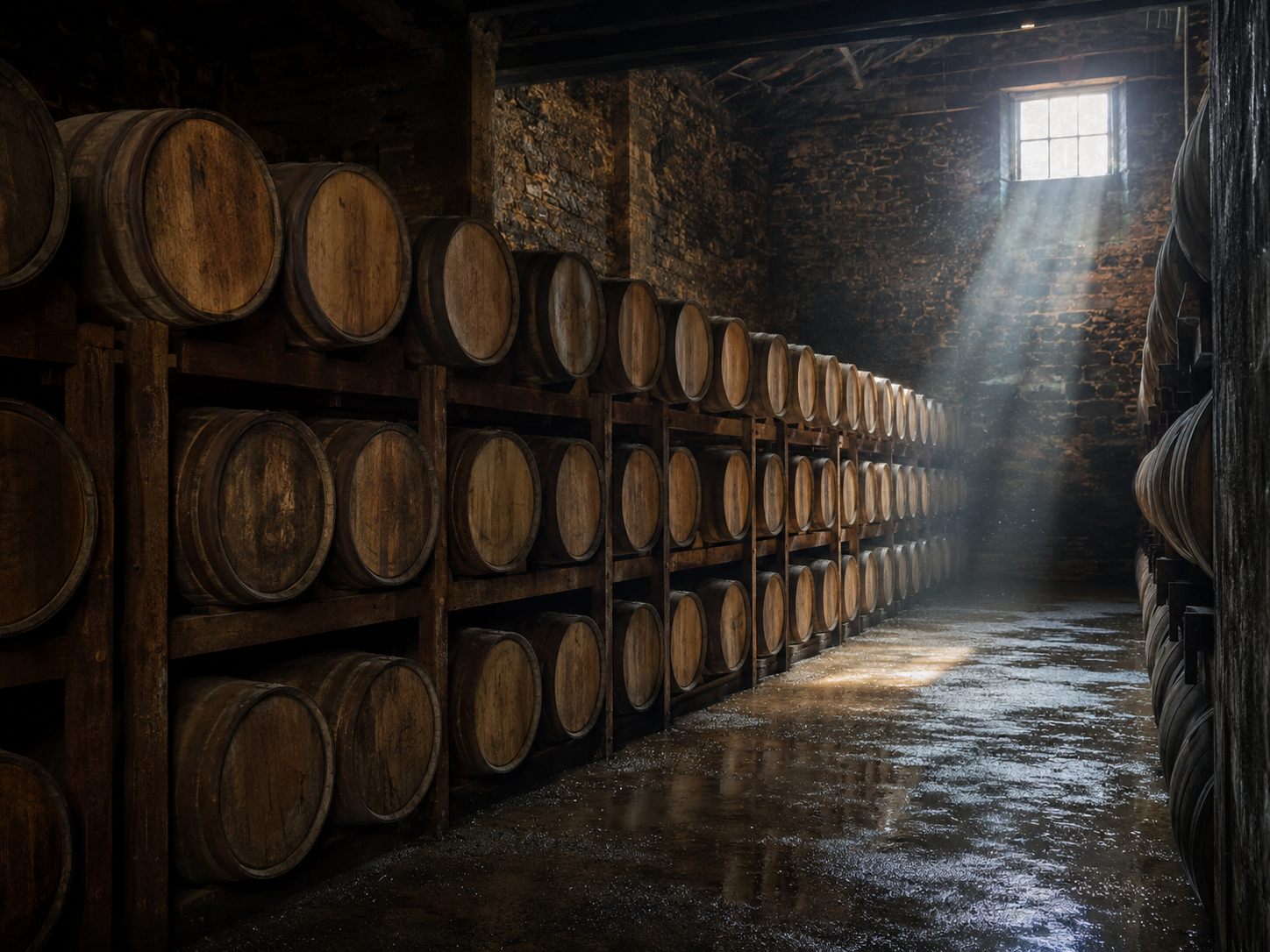
Every whisky in the world is made the same way: ferment a grain mash, distil it, put it in oak, wait. What separates Scotch from bourbon from Canadian whisky is which grain, which barrel, and which country’s rules apply. That’s genuinely most of it.
The names sound like a connoisseur’s obstacle course. They’re closer to shipping labels.
Whisky or whiskey?
Spelling follows geography. Scotland, Canada and Japan write whisky. Ireland and the United States generally write whiskey. It tells you where the bottle is from and nothing whatsoever about quality. Canadian producers use the Scottish spelling, which is why you’ll see it both ways on the same shelf.
The five you’ll actually meet
| Type | Made from | Barrel | Tastes like |
|---|---|---|---|
| Scotch | Malted barley (single malt) or a blend with grain whisky | Used oak, min 3 years, in Scotland | Malty, dried fruit, sometimes peat smoke |
| Bourbon | At least 51% corn | New charred oak, in the USA | Sweet, vanilla, caramel, baking spice |
| American rye | At least 51% rye | New charred oak, in the USA | Drier, peppery, spicy |
| Irish | Barley, often a mix of malted and unmalted | Oak, min 3 years, in Ireland | Light, smooth, gentle — usually triple distilled |
| Canadian | Mostly corn, with rye and other grains | Small wood, min 3 years, in Canada | Light, smooth, faintly spicy |
Why Canadian whisky is called “rye” when it often isn’t
This confuses almost everyone, including Canadians. Ask for a rye and ginger anywhere in Ontario and you’ll be handed Canadian whisky, which may contain very little rye grain at all.
The habit is historical. Early Canadian distillers added rye to corn mash for flavour, drinkers began asking for “the rye whisky”, and the name stuck to the whole category regardless of what went into it. In Canada the terms rye whisky and Canadian whisky are legally interchangeable.
American rye is a different thing entirely — a legal minimum of 51% rye grain, and noticeably drier and spicier as a result. If a recipe calls for rye and you use Canadian whisky, the drink will come out softer and sweeter than intended. Not wrong, just different.
If you want to see the range Ontario actually stocks, the LCBO carries more Canadian whisky than most people realise, and a good deal of it sits well below the price of imported single malt.
Canadian whisky also has a quirk no other category shares: producers may add a small proportion — up to about 9% — of other spirit or wine to the blend. It’s part of why Canadian whisky tends toward smooth and approachable rather than assertive.
The peat question
Peat is the single biggest fork in Scotch, and the reason people who say they hate Scotch often just hate one kind of it.
Barley has to be dried before it’s malted. Dry it over a peat fire and the smoke saturates the grain, producing that medicinal, bonfire, iodine character. Islay whiskies lean hard into it. Speyside whiskies generally don’t touch it and taste of apple, honey and dried fruit instead.
If someone tried Islay Scotch once and swore off the category, they’ve tasted roughly one flavour out of a very wide range. Start them on a Speyside.
Where to start, depending on what you like
- You like sweet things: bourbon. Vanilla and caramel come from the new charred oak, and it’s the friendliest entry point in the whole category.
- You find whisky harsh: Irish. Triple distillation makes it lighter, and it’s forgiving neat.
- You want to mix: Canadian whisky or bourbon. Both hold up against ginger ale, cola or vermouth without disappearing.
- You want cocktails with backbone: American rye. An Old Fashioned or Manhattan made with rye has an edge that bourbon smooths away.
- You like smoke: peated Scotch. Nothing else in the drinks world tastes like it.
- You’ve been put off Scotch before: a Speyside single malt. No smoke, plenty of fruit.
How to drink it
Neat first, to see what’s actually there. Then add a few drops of water — genuinely a few, from a spoon. Water lowers the alcohol slightly and releases aromatic compounds that were locked up; on a cask-strength whisky the difference is dramatic, and it isn’t a compromise. Distillers do it themselves.
Ice is fine if you prefer it cold, with one caveat: cold mutes aroma, and aroma is most of flavour. A large cube melts more slowly than several small ones and dilutes less.
The glass matters more than people expect. Anything that narrows at the top concentrates the aroma. A tumbler looks the part but lets everything escape.
Three cocktails worth knowing
Old Fashioned. Two ounces of bourbon or rye, a bar spoon of sugar syrup, two dashes of bitters, stirred over ice with an orange twist. The oldest cocktail template there is, and the best test of a whisky you’re unsure about.

Whisky sour. Two parts whisky, one part fresh lemon, three-quarters part sugar syrup. Shake hard. Fresh lemon is not optional.
Rye and ginger. Canadian whisky, ginger ale, ice, lime wedge. Utterly unpretentious and it’s what most of the country is actually drinking.
Age statements, briefly
The number on the bottle is the youngest whisky in it, not the average. Older is not automatically better — it’s more oak, which suits some spirits and overwhelms others. Plenty of excellent whisky carries no age statement at all.
Spend the extra money on something you’ll drink often rather than on a number you’ll keep in a cupboard.
The short version
Grain, barrel, geography. Corn and new oak give you sweet; rye gives you spice; barley and used oak give you malt and fruit; peat gives you smoke. Canadian whisky is smooth and mixes beautifully, and calling it rye is a historical accident everyone has agreed to live with.
You can see what’s in stock on the whisky page or across the full menu. We deliver throughout Toronto and the GTA — call or text (416) 988-3623.